Why Zillow and Automated Home Values Can Miss the Mark in Jupiter, Florida
If you own a home in Jupiter, Florida, an automated home value can be a useful starting point. It is not the same thing as a pricing strategy, and that distinction matters here.
Jupiter real estate is unusually sensitive to details that are difficult for an algorithm to fully understand. Two homes can have similar square footage, bedroom counts, lot sizes, and even the same ZIP code, yet appeal to buyers very differently because of the neighborhood, the street, the renovation quality, the water, the view, the dock, or the route to the inlet.
Zillow itself makes an important distinction. A Zestimate is an automated estimate of market value, not an appraisal, and its accuracy depends in part on the amount and quality of available data.
That matters even more in a market like Jupiter, where the spreadsheet rarely tells the whole story.
Why can an automated estimate be inaccurate for a Jupiter home?
Automated valuation models, or AVMs, are very good at processing data. They can analyze square footage, bedrooms, bathrooms, lot size, prior sales, tax records, comparable properties, and broader market trends at a scale no human could reasonably match.
What they cannot always do is understand why a buyer will pay more for one Jupiter property than another.
That "why" is often where the real value lives.
A model may see two four-bedroom homes within a few streets of each other. A Jupiter buyer may see one home on a highly desirable street with a beautifully renovated interior, better exposure, more privacy, and stronger neighborhood demand, while the other simply does not compete the same way.
On paper, the homes may look similar. In the market, they may not be close at all.
Neighborhood demand is not uniform across Jupiter
One of the biggest problems with automated home values is that Jupiter does not behave like one giant, interchangeable housing market.
Buyer demand can vary substantially between communities and even between pockets within the same general area. Proximity to the beach, Intracoastal, river, or Jupiter Inlet can matter. So can whether a community is gated, the size and privacy of the lot, club or golf considerations, neighborhood amenities, architectural consistency, and how often a particular property type becomes available.
An automated valuation can recognize location. What is harder to quantify is the intensity of buyer demand for a very specific location at a very specific moment.
That is one reason I would never price a Jupiter home simply by taking an online estimate and moving the number up or down a few percentage points. I want to know what buyers are actively choosing between right now, because that is the real competition.
Not all Jupiter waterfront is created equal
This is probably one of the clearest examples of where automated home values can struggle.
"Waterfront" is not a single category.
In Jupiter, the caliber of the waterfront can materially change how buyers perceive a property. A home with water behind it may technically be waterfront, but buyers are looking at much more than that label.
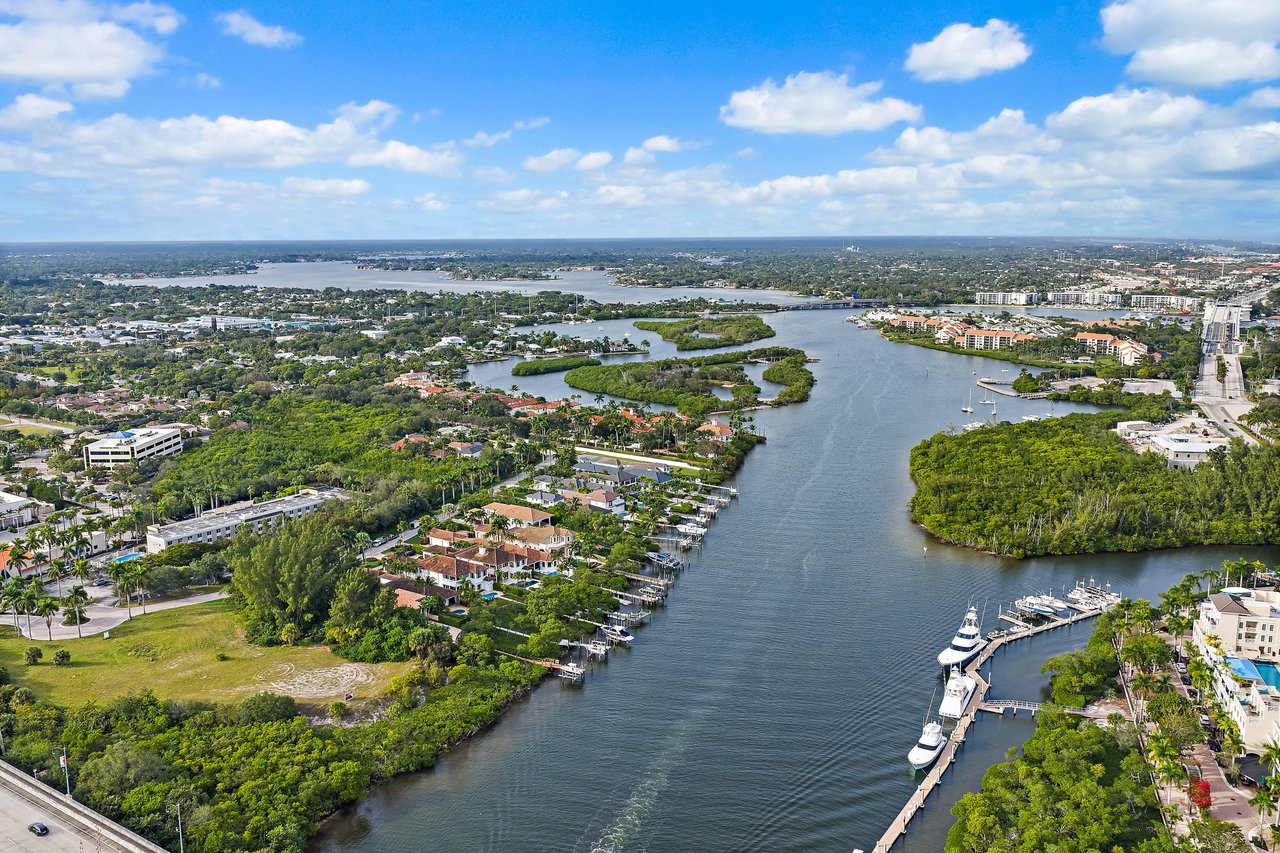
They care about what body of water the home is on, whether it is ocean, Intracoastal, Loxahatchee River, canal, lake, or preserve-facing water. They care about how wide the water is, what the exposure is, how much frontage the property has, and what the home actually looks at.
They may also care very specifically about boating access. For a serious boater, the route from the dock to the inlet can matter almost as much as the house itself. Fixed bridges, bridge clearance, water depth, lift capacity, seawall condition, turning room, and dock configuration can all affect how desirable a property is to that buyer.
An algorithm may be able to register "waterfront: yes."
A buyer does not think that way.
The route to the Jupiter Inlet can have real value
For boating buyers, location is measured differently. Driving distance may matter, but so does boating time.
A home with relatively convenient access toward the Jupiter Inlet may command a different level of interest from a serious boating buyer than a seemingly comparable property farther inland or behind navigational constraints.
An automated model may pick up some of this indirectly through historical sales, but it cannot stand at the dock and evaluate the total boating experience. That distinction becomes especially important when comparable sales are limited.
And unique waterfront homes are, by definition, harder to compare.
Renovation quality is harder to quantify than renovation status
Another place I see automated values lose nuance is condition.
There is a major difference between a home that is simply described as "renovated" and one that has been renovated in a way today's Jupiter buyer actually values.
An algorithm may know that the kitchen was updated. It may not know whether the renovation was completed three years ago with timeless materials or fifteen years ago with finishes buyers now expect to replace.
It may not fully understand the difference between builder-grade improvements and custom millwork, basic replacement windows and a comprehensive impact-glass package, a refreshed kitchen and a true luxury renovation, or a home that photographs beautifully but still has major systems approaching the end of their useful lives.
Those differences can become significant once buyers begin comparing homes in person.
The street matters more than people think
Real estate has always been local, but sometimes "local" means one street.
A home may sit within the same neighborhood as a recent comparable sale and still have a different value proposition because of traffic, cul-de-sac location, corner positioning, privacy, adjacent properties, rear exposure, water orientation, noise, or the way the home sits on the lot.
Algorithms are getting better at interpreting location data, but there is still no substitute for understanding how buyers perceive the property once they arrive.
I care about what the data says, but I also care about what happens when someone pulls into the driveway.
Automated estimates can be especially tricky when there are few good comparable sales
Comparable sales are strongest when the homes are actually comparable.
That sounds obvious, but it becomes a problem in Jupiter because many neighborhoods contain a wide range of lot sizes, renovation levels, construction eras, waterfront conditions, architectural styles, and overall property quality.
If the best recent sale is meaningfully inferior or superior to your home, simply adjusting price per square foot can create a false sense of precision.
Price per square foot is a useful metric. It is not a pricing strategy.
A beautifully renovated home on a premium lot should not automatically be valued like an original-condition property nearby simply because their square footage is similar.
A Zestimate can also be working with incomplete information
Automated valuation models are only as good as the data available to them.
A model may know you have 3,200 square feet. It may not fully understand that you just completed an extensive renovation, reconfigured the primary suite, replaced the roof, installed impact glass, rebuilt the dock, redid the pool, and transformed the outdoor living space.
Eventually, some of those details may make their way into the data.
Buyer perception changes immediately.
That gap between what the database knows and what the market can see is one of the reasons automated home values can miss the mark.
How I look at the value of a Jupiter home
When I evaluate a property, I do not start with the question, "What does Zillow say?"
I start with the home itself.
First, I look at the micro-location. That means the neighborhood, the street, the lot position, the privacy, the immediate surroundings, and any characteristics that make that particular piece of property more or less desirable than another one nearby.
Then I look at buyer demand. Who is most likely to want this home? What matters to that buyer, and what other homes are they considering right now?
If the property is waterfront, I go much deeper than simply checking a waterfront box. I look at the type of water, frontage, view, exposure, dockage, depth, bridge restrictions, seawall condition, and boating access.
I also look closely at condition and renovation caliber. I want to know whether the improvements actually move the property into a different competitive set or whether they simply make it more presentable.
From there, I study the recent sales that are genuinely comparable, not just geographically close. I also look at active competition, because a buyer is not choosing your home against last year's market. They are choosing it against what they can buy today.
Then I look at the property-specific features that may be difficult to replicate, including lot size, outdoor living, garage capacity, ceiling height, floor plan, impact protection, privacy, orientation, and other meaningful differentiators.
Finally, I layer in current market timing, including inventory, buyer activity, and how quickly comparable properties are moving.
The number comes after that analysis, not before it.
Should you ignore your Zestimate?
No. I would look at it.
I would also look at other automated estimates, recent sales, current listings, and your Palm Beach County property information. More information is useful.
The mistake is treating one automated number as the answer.
For a relatively standardized home in a neighborhood with many recent, highly comparable sales, an AVM may get quite close.
For a unique Jupiter property, especially waterfront, extensively renovated, unusually positioned, or located in a neighborhood with limited turnover, I would want much more context before making a pricing decision.
What should a Jupiter seller do before choosing a list price?
Before deciding what your home is worth, I would want answers to a few key questions.
Which recent sales would today's buyer genuinely consider comparable? Which current listings are competing for that same buyer? Is your specific neighborhood gaining or losing inventory? Does your lot command a premium within the community? If the home is waterfront, what is the actual caliber of the water and boating access?
I would also look at how your renovation level compares with the homes buyers are seeing now, what features would be difficult or expensive for a buyer to recreate, and whether there are defects or upcoming capital expenses that a buyer is likely to factor into an offer.
Then there is the broader market question. How much negotiating room does the current market support, and what price gives the home the strongest strategic position?
That last question matters.
The goal is not to win the listing-price contest. The goal is to understand where the market is likely to respond.
What is my Jupiter home actually worth?
Your automated home value is one data point.
Your home's market value is ultimately shaped by what a qualified buyer is willing to pay after comparing your property with the alternatives available to them.
In Jupiter, those comparisons can get very specific.
Neighborhood demand matters. Street position matters. Renovation quality matters. The caliber of your waterfront matters. For boating properties, the dock and route to the inlet can matter. Sometimes two houses that look almost identical in a database are not remotely identical once you understand how buyers experience them.
That is where local analysis earns its keep.
If you are considering selling and want to understand how I would position your property in the current Jupiter real estate market, a Confidential Jupiter Seller Strategy Session is designed to do exactly that. We can look at the automated estimates, but we will also look at everything the algorithm cannot see.
Frequently Asked Questions About Automated Home Values in Jupiter
Are Zillow Zestimates accurate in Jupiter, Florida?
They can be useful as a starting point, but accuracy varies by property and available data. Unique homes, waterfront properties, heavily renovated homes, and properties with few recent comparable sales may require considerably more analysis.
Why is my Zestimate lower than nearby home sales?
The model may be using different comparable properties, incomplete home information, broader geographic trends, or adjustments that do not fully capture your home's renovation level, lot quality, waterfront characteristics, or micro-location.
Does Zillow know if my Jupiter home was renovated?
It may incorporate renovation information when that information is available through public records, MLS information, owner updates, or other data sources. That does not necessarily mean an automated model can evaluate the quality of the renovation the same way a buyer will.
Does waterfront automatically make a Jupiter home more valuable?
Waterfront generally changes the value equation, but the type and caliber of waterfront matter enormously. Water frontage, view, exposure, dockage, navigability, bridge restrictions, depth, and proximity to boating destinations can all affect buyer demand.
Is price per square foot a good way to value a Jupiter home?
It is one useful metric, but relying on it alone can be misleading. Two similarly sized homes may differ substantially in lot quality, renovation level, view, waterfront access, floor plan, and buyer appeal.
Should I price my home at the Zestimate?
Not automatically. A seller should evaluate recent comparable sales, active competition, property condition, specific neighborhood demand, and the home's unique characteristics before choosing a pricing strategy.
What is the best way to determine my Jupiter home's value?
Use multiple data points, then add property-specific analysis. For a potential sale, that means examining true comparable sales, current competition, micro-location, condition, buyer demand, and any features that make the property meaningfully better or worse than nearby alternatives.
About Katie Lucie
Katie Lucie is a Jupiter native, former research scientist, evidence-first homeownership advisor, and real estate agent with ONE Sotheby’s International Realty. Her approach combines local knowledge with careful analysis so Jupiter and Palm Beach County buyers and sellers can make better-informed real estate decisions.